 CloudBoost
Measured session · July 20, 2026
One real League session.
A 42-minute native League of Legends session on macOS, recorded by CloudBoost PRO and checked against a separate five-minute sample.
This is evidence that the diagnostics ran and remained lightweight. It is not proof that CloudBoost increases FPS or guarantees lower latency.
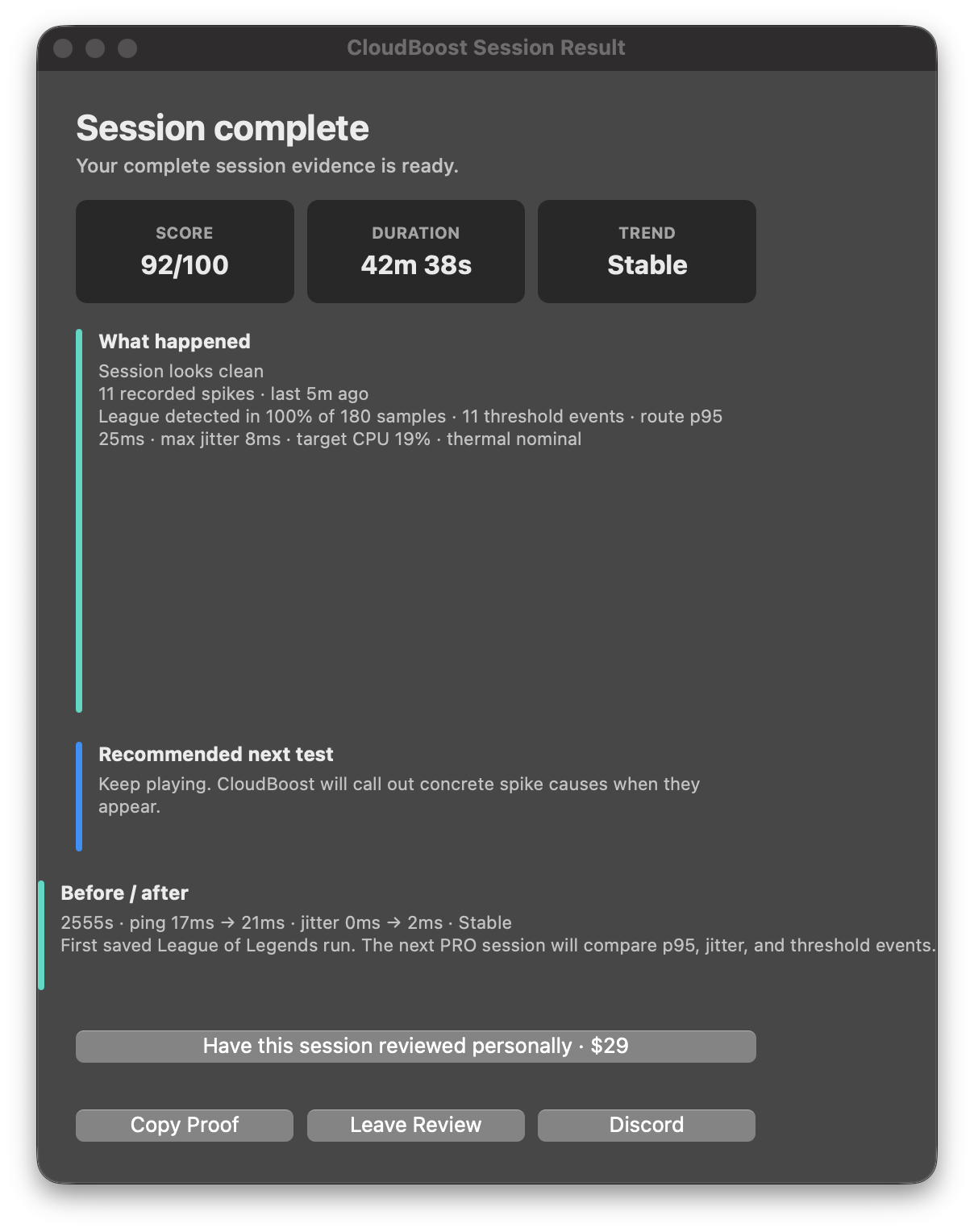
What CloudBoost recorded
The game was present for the full benchmark.
CloudBoost detected League in 100% of 180 benchmark samples, recorded 11 threshold events, measured a 25 ms route p95 and kept thermal pressure nominal.
The app also identified iCloud Drive as session interference. The Session Lab classified the Mac-side pressure as clean and explicitly recommended looking next at shaders, asset streaming, the game engine or translation if visible stutter remained.
Independent sample
CloudBoost stayed lightweight.
A separate 60-sample window ran every five seconds during the match. It measured 17.9 ms median external latency, 22.2 ms p95 and 30.0 ms maximum.
CloudBoost used 1.68% CPU on average and 46.1 MB of memory during that sample. League averaged 74.5% process CPU. CloudBoost's in-app target CPU value is normalized by active CPU capacity and should not be compared directly with the process percentage.
Limits
What this result does not prove.
Only the PRO session was measured. There was no matching control session without CloudBoost, so this result cannot establish an FPS gain or a latency reduction caused by the app.
The test build was CloudBoost 4.3.1-test1 on a macOS 27 beta build over Wi-Fi. Router, route, Mac model, macOS version, game patch and background workload can all change the result.
This page exists to make the evidence inspectable, including the parts that do not support a marketing claim.